
Held, Michaels’s third novel, is divided into twelve fragmented sections that jump between 1902 and 2025, not in chronological order. It is set mostly in England, but also in other parts of Europe; and is peopled by a large cast of characters with varyingly degrees of connection. Critics have likened the fragments to snapshots. Several themes are woven into the narrative: that there is meaning and value in what cannot always be proven; the loss of loved ones and their continued presence; and our place and purpose in a world of magical things that exist a little beyond our understanding. The search moves through history, seeking illumination from Charles Darwin, Sir Ernest Rutherford, folklorist Ella Mary Leather, North Sea ganseys, modern field hospitals and early photography. The latter is explored through two stories within the overall narrative. Though Michaels does not say so, both have antecedents in the history of photography.
In the first, it is 1920 and John has returned to North Yorkshire to be reunited with Helena, an artist. He reopens his photography business and Helena paints romantic backdrops for his studio. Lame through a war wound, John needs help and he hires an assistant, Robert Stanley, who claims to be an ex-soldier and carries copies of The Worker in his pocket. Their relationship is initially amicable and convenient, not intimate.
Customers find him quickly and are eager for family portraits.
‘They came wearing their best clothes. The men preferred to sit, disguising an amputation or a brace, others posed in profile to omit from view an eyepatch, scars, profounder disfigurements. John new the necessity of these portraits for wives and mothers – proof of a homecoming, an argument for believing family life had resumed, evidence of various forms and degrees of survival and return.’
John trusts, and comes to depend on, the work of Stanley in the studio and darkroom.
‘They were setting up for a family portrait, unrolling the mountains and draping the table with a long cloth that would obscure the vanished limb of one of the sitters. The first time they worked together, John had brought out the cloth and explained what it was for – “to hide what’s invisible, and to hide what mustn’t be seen”. He told Mr Stanley he would have preferred to photograph the truth – not to provoke pity, but to enrage.’
Stanley is dismissive of this and John is wary of his contempt.
A customer, a young man, arrives at the studio. ‘He wanted his photograph taken to give to his father. His mother had died while he was in the war, he explained, and now he was leaving for a job away and his father would again be alone’. John loads the holder containing a plate into the camera and takes a standing portrait.
After dinner John develops and fixes the plate. The portrait is ‘beautifully clear and evocatively lit’, a young man ‘handsome and whole in body.’ ‘And beside him, semi-opaque but perfectly distinct, an older woman, well dressed, pearl buttons, her fine head and lustrous hair, and her expression of intolerable longing.’
John is shocked and confused. The plate had been completely clean, it was properly processed and there was no possibility of tampering. He did not recognise the woman. He asks himself if this is a sign sent by a spirit in a form that would be recognised, hard to ignore. He speculates as to whether the image is the result of some other process in the realms of radiation and ‘thermionic emission’, a manifestation of the invisible. ‘The camera sees more than the naked eye, grasps details that elude our perception, it supersedes our vision – every fibre of embroidery, every hair in a beard. Sometimes, surely, detects even thought.’
He makes prints for the young man and locks two in a drawer for himself. Next morning, he shows the prints to Stanley, who thinks it is some trickery, ‘expertly done’, by John. John demurs; they check the studio and the equipment and Stanley accepts John’s word. They decide to show the young man the photograph; he declares, ‘”It’s my mother…She’s come to say Goodbye”’. The young man thinks it’s a miracle and wishes to let people know. John does not want that: ‘”It might never happen again, we can’t let people hope”’. The young man agrees. After he leaves, Stanley tries to persuade John that they should exploit the opportunity offered by those who have and haven’t come back from the war.
Apparitions appear in two more sets of photographs; and John and Stanley argue about the morality of giving, selling, hope. They work on, increasingly uneasily, until one day Stanley disappears with money and the spirit photographs. Had Stanley somehow manipulated the photographs?
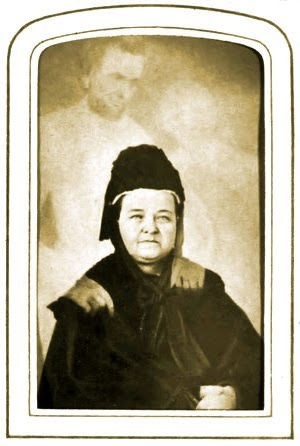
This story resonates strongly with the real life one of the charlatan photographer William Mumler (1831-84). He created spirit photographs trading on grief and loss in the wake of the American Civil War. His two most famous images are the photograph of Mary Todd Lincoln with the ghost of her husband Abraham Lincoln and the portrait of Master Herrod, a medium, with three spirit guides. He was charged with fraud and taken to court, but acquitted because no one could prove how he had made the images. (They were simple double exposures.) There is also a domestic link with the Cottingley Fairies, patently fake photographs taken by Elsie Wright (1901-88) and Frances Griffiths (1907-86) in 1917. Published in 1920, the pictures gained great currency in a climate when people sought solace in spiritualism after the First World War.
The second story is set in Sceaux, France, during 1910. Lia is out walking in the forest.
‘At first, in the distance, Lia saw only the camera, like a wooden birdhouse atop its tripod, its bellows and black shroud, and a leather bag open on the ground. Then she saw the photographer disappearing under the black fabric, as if under a woman’s skirts.’
The photographer, an older man and unnamed, explains.
‘”The last time I photographed this place was twenty years ago.”’
‘”Why did you come back?”’
‘”I thought I wanted to see if it had changed.” He smiled. “But maybe I wanted proof that it was the same.”’
‘”I usually photograph the city,” he added.’
‘”Why do you do it?”’
‘He shrugged. “To keep a record.”’
He elaborates.
‘”You don’t need a camera to see or to remember”, he said, “but you need a camera for proof of what is no longer – so that others can remember. I didn’t set out to eulogise, but that’s what my work has become. Over twenty years, for example, I’ve captures every detail of the streets of Saint-Severin, even their demolition, and now all that’s been lost survives only on those glass plates.”’
And explains his method. ‘”I like to take two photographs from the same place in the street,” he said, “the camera facing one direction, then the camera facing the opposite direction.”’ He adds that he had been a soldier, a sailor and an actor; that he had never had enough money to think about having a family and now just wanted to record everything before it was gone.
Lia asks if he has photographs she can see.
‘She looked at his photographs of streets and shopfronts, shop windows of mannequins dressed up and waiting for an event that never happens, details of ironwork, staircases, door latches; … Every feature of the plangent stillness. She could not tell if the melancholy was inherent to what had been photographed, or to the photographer, or to the act of photography. It was something about possession, she thought, about acknowledging what can never belong to you, how we have no right to that nostalgia, and yet, seeing creates a memory, or confers a memory, or confirms a memory…’
‘”Why are the streets always deserted?” She asked.’
‘”If you hold the shutter open long enough, everything moving disappears.”’
‘She thought several things then. That a photographer’s entire life’s work would add up to only a few minutes of time. And that one could make a long exposure – say, thirty years of married life, or family life in a kitchen, infants growing to adults – and all the photographic plate would show was an empty room.’
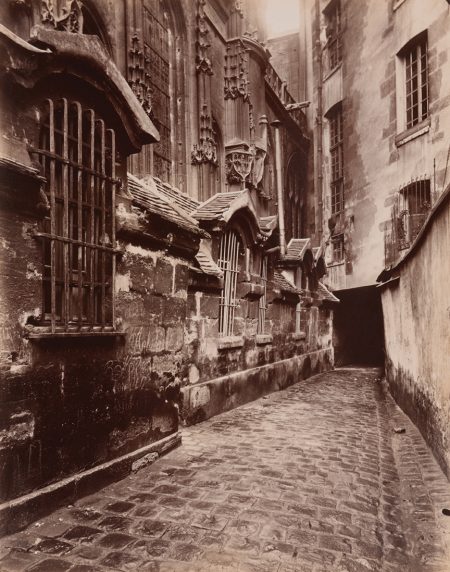
It takes little stretch of the imagination here to see that the photographer is based on Eugene Atget (1857-1927). A revered figure in the history of photography, he was a French flâneur and a pioneer of documentary photography, who obsessively documented the architecture and street scenes of Paris before their disappearance to modernization.
Held contains narratives that elaborate the practice and nature of photography in the context of a wider exploration of memory and remembrance. It becomes a leitmotif as the stories of the characters delve into the mysteries of desire and meaning of life and death. Images are seen to feed into an insistence that the dead are never gone: ‘We know life is finite. Why should we believe death lasts forever?’ Does memory defeat death? Is photography an aide to this?
Perhaps Brian Patten caught this in his poem, ‘So Many Different Lengths of Time’:
A man lives for as long as we carry him inside us,
for as long as we carry the harvest of his dreams,
for as long as we ourselves live,
holding memories in common, a man lives.