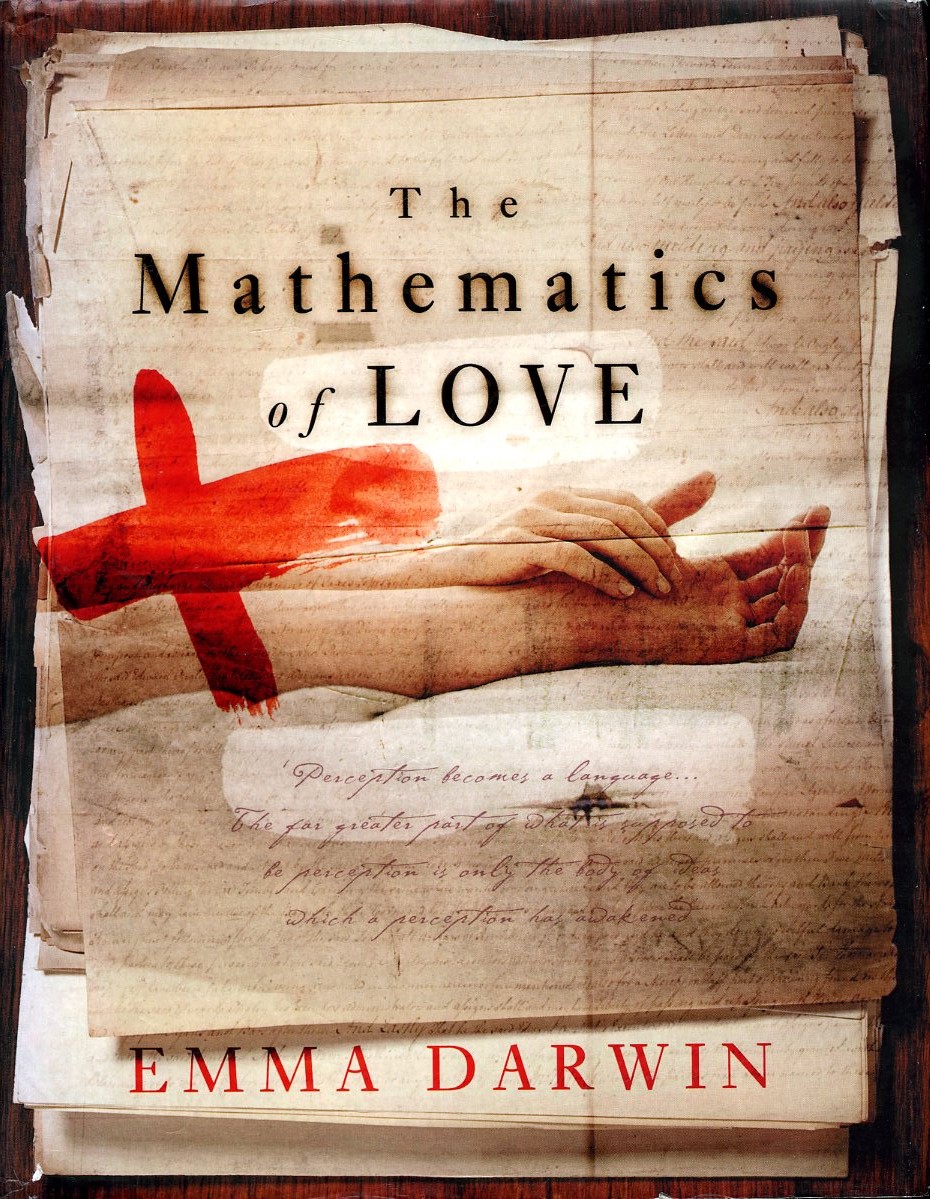
The Mathematics of Love by Emma Darwin is about two people, separated by two and a half centuries, whose lives intersect in a story woven from memory and time.
Stephen Fairhurst is a veteran of the Peninsular War and Waterloo, which have robbed him of a leg and his great Spanish love, Catalina. He returns to England in 1819 to take over the family estate at Kersey in Suffolk. He meets Lucy Durwood, an artist, and they enter into a long correspondence – she uses his descriptions of war to bring truth her artwork, which is reproduced as prints. Aided by Lucy, Fairhurst embarks on a real and metaphorical road to redemption – along which Lucy sketches obsessively – where old ghosts are laid and no longer haunt him.
In the long hot summer of 1976, 15-year-old Anna Ware comes to live in Fairhurst’s old home, Kersey Hall, with her dysfunctional uncle and grandmother, while her mother is in Spain. The Hall has been used as a school, which has just closed down. Anna is given copies of Fairhurst’s letters by Crispin, a gallery curator, and she becomes intrigued by his story. Left to her own devices she is befriended by photographers Eva and Theo.
Photography is a strand running through the novel.
Setting the Fairhurst part of the narrative in the years following Waterloo (1815) puts it prior to the date of the earliest known photograph by Niepce (View from the Window at Le Gras, 1826-7) and well before the seminal work of Fox Talbot and Louis Daguerre (1835-38). But the author contrives a connection. Lucy’s nephew, Tom, is injured at the Peterloo Massacre and a doctor is called. Though we are no told as much, he is clearly Robert Darwin, father of Charles Darwin. The child tended to, Lucy talks to the doctor about ‘mechanical reproduction’. Darwin explains, ‘“The key seems to be the knowledge of which substances are affected by the action of light, and how they are thus affected. My brother-in-law Thomas Wedgewood was much taken up with the question. I think he knew more about it than any man.’” He goes on, ‘“He died two years ago. But his paper – or, rather, my good friend [Humphrey] Davey’s paper on his work was published by the Royal Institution [1802]’”. Wedgewood (1771-1805) is credited as the first person to have thought of creating permanent pictures by capturing images on material coated with silver nitrate. His practical experiments yielded shadow images, photograms, that were not light-fast, but work has led some to claim him as the first photographer.
Later, on a visit to Brussels where Fairhurst is acting as a guide, Lucy recounts a visit to Josiah Wedgewood II, who shows her his brother Thomas’s ‘sun-pictures’. ‘“[I]t was not easy to make out the images, for they must be kept in the dark, lest they darken further, and may only be looked at by candle light. Mr Wedgewood explained how his brother brushed paper or white leather with nitrate of silver – in solution, you understand – and then the object to be copied was placed on top of it, and the whole put in the sun. It took only a few minutes, he said, if the sun was strong enough”’. Lucy reports that Thomas had tried to copy prints with a camera obscura, but time blurred the picture; he had also used muriate of silver (silver chloride) but it was difficult to work with.
At the prompting of a print dealer, she heads for Burgundy and visits Niepce in Chalon Sur Saone. She describes to Fairhurst how Niépce has been using muriate of silver and a camera obscura to make ‘“images of the view from windows – roof, and a dovecote’”; and notes that the images ‘“…were reversed, what is light in life is black’”. Niepce’s use of silver puts the date at 1829 or later and I’m not sure this is entirely consistent with the chronology of the narrative.
In 1970s Kersey, Theo and Eva approach photography from different directions. Theo is a photojournalist, documentary photographer and a member of Magnum; he has worked in Spain during the Civil Way, in Berlin at the end of the 1940s and in Vietnam. Eva, much younger than Theo, is a fine art photographer focusing on objects and places and moving in exalted art and celebrity circles. She wants to go beyond reportage and is concerned about posterity, the proof of her existence. Theo want to show the world what it does to itself, hoping that something will change; Eva seeks the ‘measure of all things, salvation in form’.
Through the couple and their conversations with Anna, the novel name-checks Tim Page, Horst Faas, Alfred Stieglitz, Andre Kertesz, Roger Fenton, Garda Taro, Lee Miller, Man Ray and Robert Capa.
Theo and Eva are setting up a joint exhibition showing their contrasting work when they meet Anna. Theo’s graphic war pictures lead to a discussion about voyeurism, beauty in ugliness and the morality of showing such pictures in a gallery, Anna seems doubtful. Later in the darkroom as he makes a print from the Spanish Civil War, Theo speaks of the need to move on, to not engage with the unknown people he photographs, he says simply, “‘We had to tell’”. Anna is uncertain about a photograph of a nude made by Eva. Theo answers in a way that confuses her: ‘“It may be about sex – allowed or transgressive and forbidden – but for the human mind, the body is also the measure of all things’”.
Theo and Eva invite Anna to work for them. They give her a camera, a Nikon F2, and begin to teach her photography, from taking the picture to processing and printing. This is dealt with deftly bringing in convincing detail of everything from the storage of materials to darkroom layout, handling film in the dark to the use of wetting agent during film washing and making contact strips to dodging and burning under the enlarger. The sense of the magic of photography transcends the details. Theo and Anna develop her film. Theo expresses the fear that all film photographers have: ‘“There is always the possibility that something has gone wrong – that there are no pictures. I have been developing films for fifty years and still feel it.’” Anna watches the dripping film unroll: ‘Clear lavender-coloured shadows and dark skies, trees and pillars and windows and faces caught click after click, coiling and springing down the film one after another so that all the distance and time between them was pressed into plain, pale bands of almost nothing.’
Theo and Eva have an open relationship, and in Eva’s absence Theo and Anna, who is not sexually naïve despite her age, embark on a short-lived passionate affair. Eva is outraged. Things fall apart at the Hall and Anna leaves and waits for her mother to return. She sees her time at the Hall as leaving shadows, as Stephen had done, shadows perhaps as a metaphor for the latent images created in photography.
Emma Darwin contrives a final photographic link between the two narratives. At the close Crispin gives Anna a Daguerreotype of a woman standing at the door of the Hall; it is captioned Idoia Jocelyn, nee Idoia Maura, Kersey, June ’41. Idoia is Stephen and Catalina’s daughter. Early in the novel there’s a flash forward to 2006; Anna is in London studying the fragile photograph: ‘And the sun moved on and took the day with it, while the plate held those shadows and kept them, and carried them to other places and to other times before it was found again. One of those times was mine.’
Photography invades the narrative, much more deeply in Anna’s story than Stephen’s, inevitably. This shows the differences in image making between the two eras, not simply at a technical level, but also in the philosophical and moral issues that it poses for the protagonists. It is done accurately, and in Anna’s story perhaps with too much detail. Did the author have an urge to get her photographic knowledge, the result of assiduous research, into print regardless? It sometimes feels like it. Indeed, this book is not about photography, but about human relationships in which Lucy and Anna could just as well have been connected through painting or music. Yet, perhaps there is something about the nature of photography that fits the story. Theo says: “‘The subject and the image co-exist for the moment that the shutter opens and closes. And then the subject decays but the image lives on unchanged.’”