

W. G. or Max Sebald, was a German writer and academic. At the time of his death in 2001, he was recognized widely for his contribution to world literature. His works, largely concerned with the themes of memory and decay, are strongly influenced by the trauma of the Second World War. They include Vertigo, The Emigrants, The Rings of Saturn and Austerlitz.
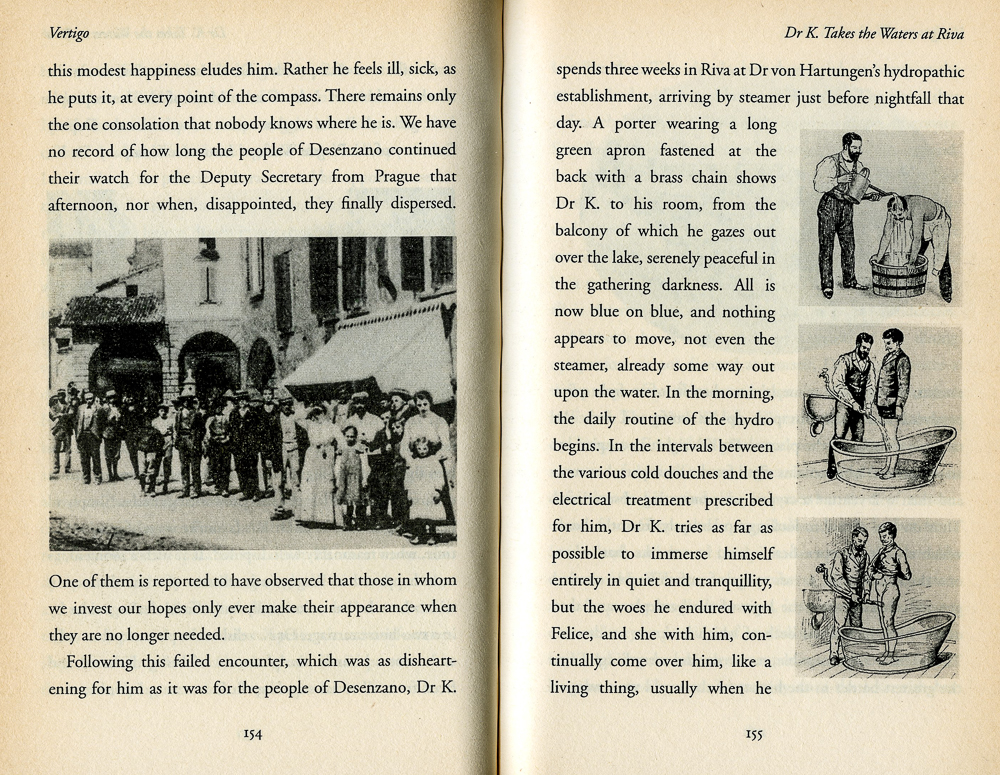
Sebald created unique worlds through a wide-ranging mixture of fact (often debatable), recollection and fiction. The texts are frequently punctuated by grainy black-and-white photographs – described by Iain Sinclair* as ‘spectral Xeroxes’ – and printed ephemera, which are mainly a counterpoint to the stories, rather than a direct illustration of them. The texts are not principally about the art and practice of photography. However, because the status of the photographs is often unclear and they give the books a visual documentary style veracity, which reinforces in their memoire like approach. We are left with the question: Are they fact or fiction?
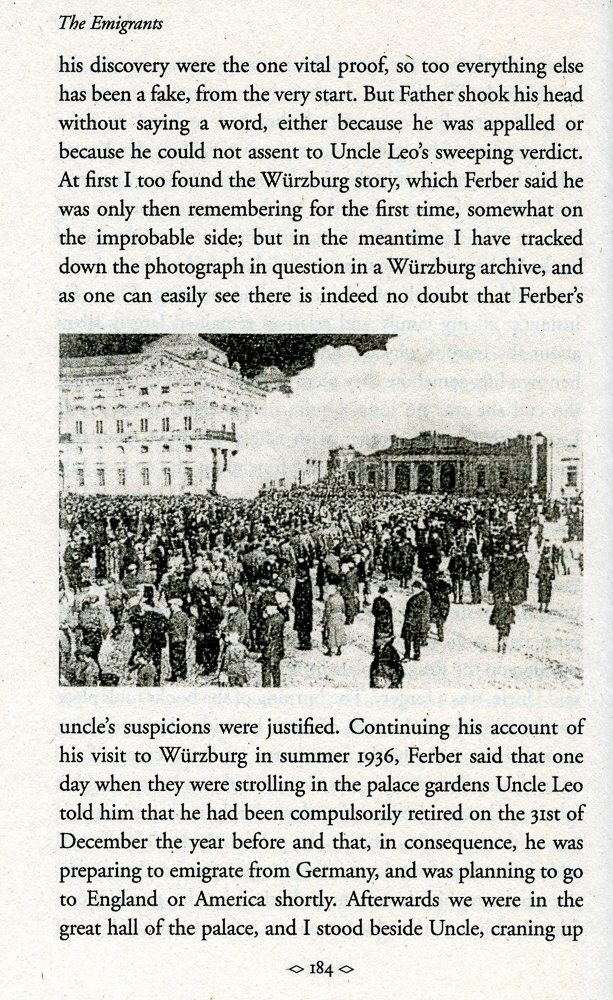
Take The Emigrants: the photographs seem sometimes to have an intimate relationship with the text and at other times no relationship at all. Sebald occasionally adds further confusion by directly interrogating the photograph, as with a (probable) fake photograph of Nazi book burning (p. 184 Vintage edition 2020). Later, there are photographs that appear to have been taken by Max himself, as opposed to the largely historical ones. The novel ends with Max describing in some detail photographs of the Litzmannstadt (Lodz) Ghetto he encounters in an exhibition.
The books can be read, understood and enjoyed without the photographs. On the other hand the photos alone can mean little as they are uncaptioned; what the text does is give the reader permission to infer meaning from otherwise abstract photographs. According to Philippa Comber*, Max considered that the, ‘use of images in a book: instead of “instructing” the reader how or what to think, [the] pictures spoke for themselves.’ Sinclair sees how they might be ‘flickered into movement’. Sebald created work in which the two media reinforce each through ‘creative distortions’.
Susan Sontag says that the accompanying photographs provide ‘an exquisite index of the pastness of the past.’ Old photographs speak of the past in a way that goes beyond the mere outdatedness of the clothes, vehicles and so on that they depict.
Sebald had a keen sense of the visual and explained his interest in photography in an interview with Maya Jaggi published posthumously in the Guardian in 2001.
‘I’ve always been interested in photographs, collecting them not systematically but randomly. They get lost, then turn up again. Two years ago in a junk shop in the East End of London, I found a postcard of the yodelling group from my home town. That is a pretty staggering experience. These old photographs always seem to have this appeal written into them, that you should tell a story behind them. In The Emigrants there is a group photograph of a large Jewish family, all wearing Bavarian costume. That one image tells you more about the history of German-Jewish aspiration than a whole monograph would do.’
A display case in the Southwold Sailors’ Reading Room records that Sebald was ‘a frequent visitor … [and] took numerous photographs of the Room’s objects and displays, including the model of the Rapid opposite. In the Rings of Saturn (1995) Sebald included a print of the bloodstained shirt of the assassinated Archduke Ferdinand and referred to the Deck Logbook of 1914. Both of these are on display here.’
It’s a side of Sebald observed by Comber. ‘In the true spirit of the bricoleur, Max had a habit of keeping an eye out for bits and pieces in junkyards and second-hand shops, making good with an assortment of found objects.’ She refers to him drawing on the notion of the bricoleur to describe a particular literary style; and says his inclusion of photographs was influenced by Alexander Kluge’s New Histories (1977).
*Ariadne’s Thread – In Memory of W. G. Sebald, Philippa Comber, propolis 2014