
In my piece on The Illuminations (blog 24th August 2026) I referred to Harry Blake being ‘associated with “The Young Meteors” a new generation of British documentary photographers’, and how Anne Quick ‘was the only woman – I mean, among the photographers [the Meteors].’ I decided to explore further.
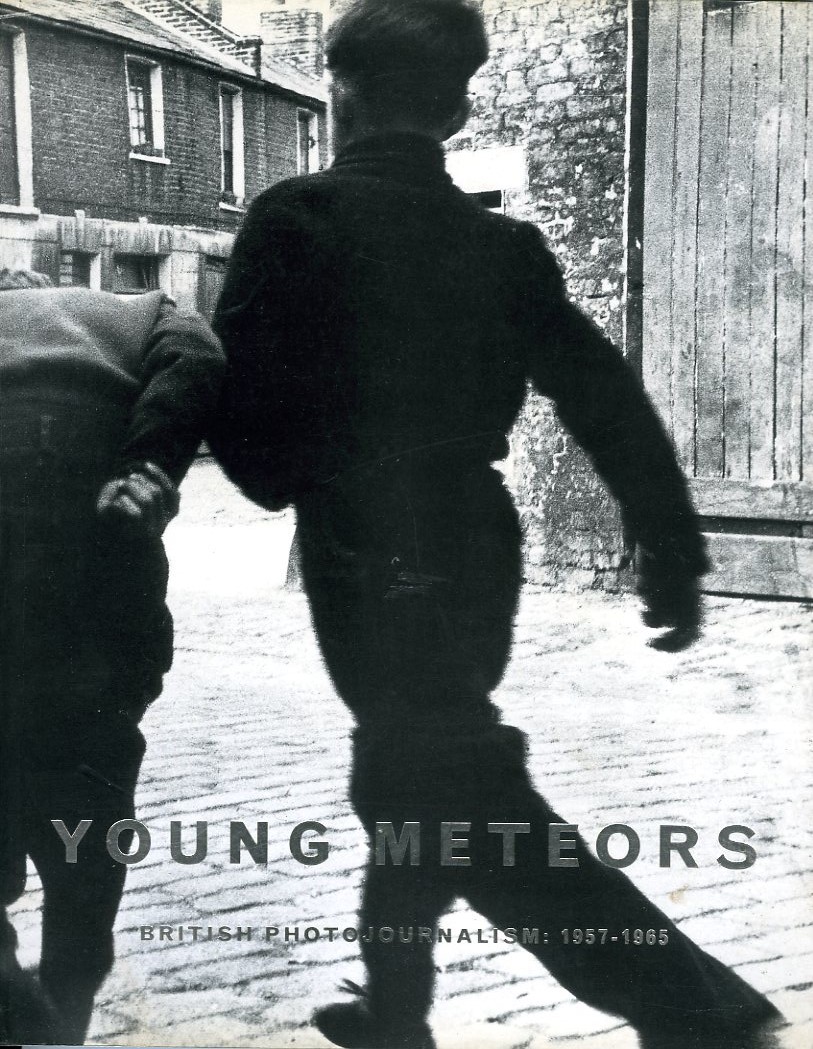
‘The Young Meteors’ were a reality and not something dreamt up by Andrew O’Hagan’s creative literary mind; and I was quickly lead to Martin Harrison’s Young Meteors – British Photojournalism 1957-1965 (Jonathan Cape 1998). Harrison explains in the preface: ‘The title “Young Meteors”, taken from Jonathan Aitken’s 1967 survey of the financial enterprise of sixties youth, denotes a specific category of photographers. All are British and were in their twenties during the period between 1957 and 1965: that is following the demise of Picture Post and up to the point when three “colour supplements” were established and Nova magazine was launched.’ Reading the book prompted a few observations: comparisons with The Illuminations and its consistency; and what happened to the Meteors.
The Illuminations makes links between Harry Blake (the teacher), Anne Quirk (the photographer) and the Meteors.
There is nothing in Harrison’s book to identify a figure equivalent to Harry Blake, though that’s not to say there wasn’t one in the 1957 to 1965 period. However, it is interesting to note that David Hurn, himself one of the Meteors, set up the School of Documentary Photography in Newport, Wales, in 1973 and taught there until the end of the 1980s. Has O’Hagan used Hurn as a model and projected him back in time?

Anne Quirk is based loosely on Margaret Watkins (1884–1969), who herself would not have qualified as one of the Meteors, though the chronology suggests that the fictional Anne could have been part of the group. O’Hagan says she was makes her the only woman there. This is consistent with the story Harrison tells: ‘Jane Bown and Grace Robertson of Picture Post were the only women to make a significant contribution to photojournalism in the 1950s.’ Harrison includes just one picture by Bown and another by Penny Tweedie in the book. It’s a familiar story and brings to mind the neglect of Shirley Baker (post 14th June 2026).
As the metaphorical name implies, the Meteors burned brightly for an all too brief period. The names of Don McCullin, David Bailey, Terence Donovan, Tony Armstrong-Jones and Philip Jones Griffiths remain well-known; some will know of John Deakin and Roger Mayne; but who remembers Peter Laurie, John Bulmer and Robert Freeman? As a sort of coda Harrison takes the story beyond 1967 to the appearance of photographic galleries, the birth of Creative Camera and the emergence of a new talents like Tony Ray-Jones, Raymond Moore and Chris Killip. He concluded: ‘The documentary mode continues as a force in photography, but the revival of large-circulation applied photojournalism, combining the aesthetic and functional elements of the Meteors is unlikely.’