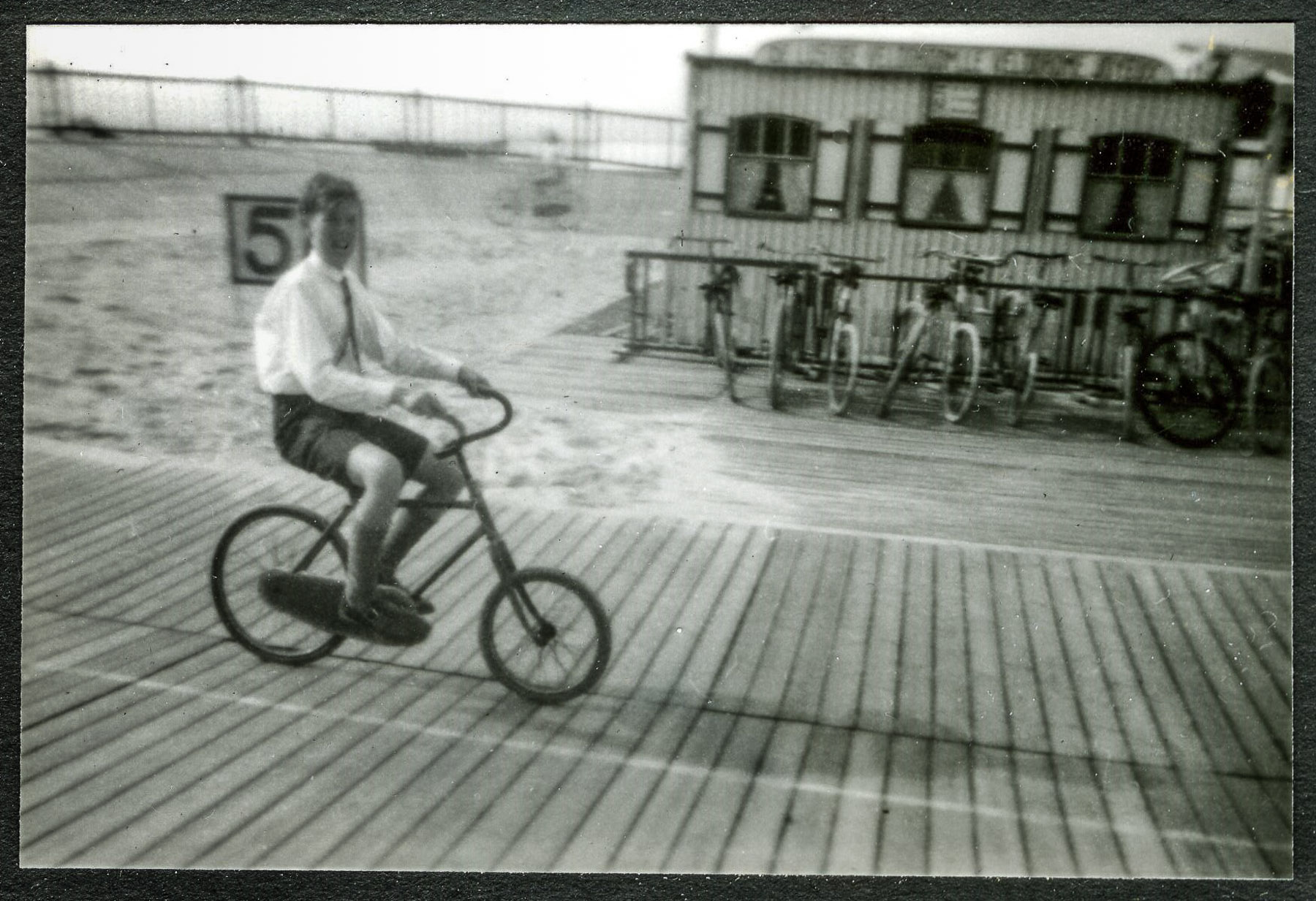
My parents were not well-off when I was growing up in the late 1940s and 1950s, the years of post war austerity. One of the few luxuries they allowed themselves was an annual family holiday, however. And having a holiday meant taking photographs to show family and friends and fix with sticky corners in albums. We used basic cameras, a Box Brownie at first, then a Brownie 127. The pictures were in black and white and we waited impatiently for the envelopes of little contact prints to come back from the chemist.
I didn’t develop an interest in photography until the 1960s – the release of Michelangelo Antonioni’s film Blow Up in 1966 made being a photographer sexy. In 1968 I went to the defining exhibition ‘Beaton Portraits, 1928-1968’ at the National Portrait Gallery, which helped to validate photography as an art. I bought a Baldi 29 folding camera that took 6 x 6 cm pictures on 120 film; and the photographer at the laboratory where I worked taught me processing and printing. I’ve been taking photographs ever since. Many of them are snapshots, I don’t use that word disparagingly, and some were taken with more serious intentions. The more considered work can’t be grouped easily into well-defined categories or genres other than to identify landscapes, street photography, attempts at travel photography and a period of photographing for local magazines from the late 1970s to the early 2000s. If I had to choose, I’d say that street photography has given me the most satisfaction.
Making photographs has been paralleled by an interest in the history and practice of the medium. My enthusiasm for individual photographers has waxed and waned; at various times I’ve been excited by the work of an eclectic mix, including Ansel Adams, Edward Weston, Sebastiao Salgado, William Klein, Graciela Iturbide, Sergio Larraine, Deborah Turbeville, Martin Parr, Francesca Woodman and Harry Gruyaert. My enthusiasms come and go, but Walker Evans, Robert Frank and Henri Cartier Bresson have stood the test of time. I’m an admirer of Geoff Dyer and John Berger as writers on photography – rather more accessible than Susan Sontag and Roland Bathes.

As part of my wider involvement with photography, I was a founder member of the St Matthews Photo Workshop (1978) and the Cambridge Darkroom (1980) and a member of the Darkroom’s board of management (1984-91). The Darkroom promoted photography through exhibitions, workshops, talks and a community darkroom. I was co-curator of the exhibition ‘Fen Archive 1850-1950’ in 1986. Since 2017 I have tried to share my knowledge and enthusiasm for photography by running courses for the Cambridge University of the Third Age (U3AC).
I believe that photography is important as an art form: it’s a medium of creative expression that improves our understanding of the world and the human condition through elements of magic, mystery and aesthetic engagement Not everyone agrees, but I take that debate as settled now, 200 years after the creation of earliest surviving photograph. Photography is also an important a means of communication and a medium of record. Sometimes, at its best, it is all three, in Robert Frank’s The Americans (1956) for example, but each of its roles individually require it to be taken seriously. In its pure form it has a central purpose that John Szarkowski called ‘the precise and lucid description of significant fact’, in talking about the work of Walker Evans. It is photography’s unique strength and sets it apart from painting, drawing and print making. There are vulnerabilities in Szarkowski’s definition, however: ‘significant fact’ may be interpreted as condemning photography to be only a medium of record; and at the same time making it simplistic in that the image is literal and gives up its meaning too easily. It’s the nature of the ‘lucid description’, making full use of photography’s faculties that is important and over the years I have owned the idea of photography as an important creative medium. Whether or not my own photography is more than a matter of communication and record is another matter.
Recently, a couple of experiences have made me re-evaluate what I’m doing, neither was concerned with photography in itself.

The first was a somewhat unlikely source of illumination. I caught up with a 2021 episode of the BBC2 show Mortimer & Whitehouse: Gone Fishing. The chummy comedy duo went fishing off North Uist in the Outer Hebrides and met Scottish contemporary landscape artist Ellis O’Connor. They sat on rocks looking across a wide sandy beach to a benign gently breaking sea, a place of space and ever changing light. She painted with freedom, quick spontaneous washes and brush strokes, the tactile qualities of paper and paint in harmony with the environment. She seemed to embody an essence of free creativity. As I watched I realised that however long I spent there with a camera my pictures would never interpret and capture the spirit of place as well as she would. Alright, that may say more about my skills as a photographer than anything fundamental about the medium, but the point is about being bound by Swarzofki’s ‘significant fact’ and the difficulty of getting beyond that in allowing feeling to guide a reinterpretation of the subject.

The second epiphany came through a U3AC course on the arts in mid-century (c. 1946-1960) New York. Centred on the poet Frank O’Hara, the course roamed through poetry (O’Hara, Barbara Guest, John Ashbury, Grace Hartigan, James Schuyler), visual art (Jackson Pollock, Willem de Kooning, Joan Mitchell, Fairfield Porter, Helen Frankenthaler, Robert Rauschenberg), and music (John Cage, Miles Davies, Billie Holiday). (It did not include photography among the visual arts, though I made four connections explored in previous posts, see 9/11/25, 13/11/25, 29/11/25 and 27/1/26) Insofar as the artists inhabited more or less the same time and space there were many direct connections between them, both personally and in the homage they paid to each other. What attracted me strongly were the connections or commonalities that existed in what they created.
First, the exploration of interior landscapes through the use of metaphor, deploying elements that defied description often in surreal collages and assemblages. Dream-like experiences were combined to create something new and elusive. The poets and painters were making unprecedented connections, going beyond the mere projection of reality to produce more conceptual work that did not give itself up easily and required attention, close reading.
Second, risk taking, aiming for effect and not relying conventional ideas about formal perfection. O’Hara’s rushed Lunch Poems distil the street scene into vivid fragmentary encounters. Pollock and de Kooning aimed for sensation and impression, not verisimilitude. Billie Holiday and Miles Davis used improvisation and mined the hard rock of experience to create unforgettable depths of feeling without the technical command of, say Sarah Vaughan and Dizzie Gillespie.
Third, the importance of process as much as the object or outcome, something that itself operates at two levels. In the creation there is a sense of going with the flow, of allowing free reign to the stream of consciousness, of a loss of control and drifting with the fragments. Rauschenberg saw the canvas as a place for an event without any preconceived image; a Miles Davis set would be the same. A true artwork then ultimately lives as a process, a relationship between the artist, the object and the audience. It’s not too much of a stretch to see the arts borrowing from the sciences where all life forms are processes not things.
What light do these insights shed on my recent photography, how might I re-evaluate it?
In recent years I’ve tried to take a more conceptual approach involving abstract images, exploring the use of multiple exposures and combining photographs with ephemera and text. It’s been a project-based way of working with elements of experimentation. I’ve made the material into photo books, such as In Plain View (2016), Undertow (2019), Footfall (2021), Traces of Erewhon (2023), Endings (2023) and Journey Round My Room (2024). Any creative expression is achieved through a completed book, not the individual photographs(s).
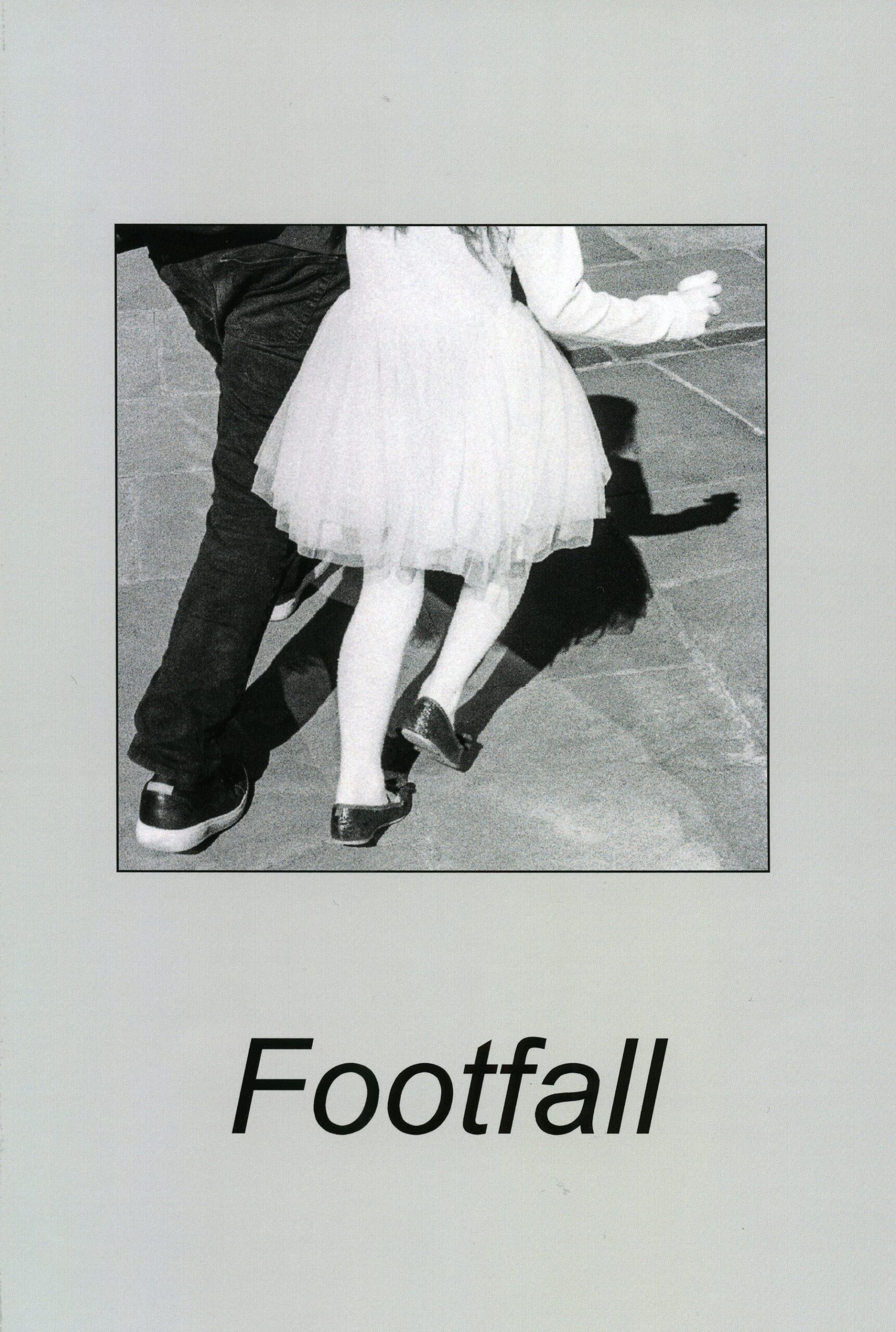
The images align with Szarkowski’s view in using the unique quality of photography. This even applies to the double exposures in which each layer is made from a ‘significant fact’ – they are essentially photographic and do not try to imitate other visual media. Combining the photographs with other images or material creates a series of interactions that expand the meaning beyond the literal subject – the collection of images becomes a voice. I want individual and sequences of images to pose the question, ‘What is it of and what is it about?’ Or looked at another way, ‘What’s the story?’, the ‘undertow’ as used in the title of one of the books. Images are used as metaphors and do not give up their meaning at a glance. This reflects the importance of reading photographs, something I’ve tried to encourage through the U3AC. Each book may be looked at in this way, such that there is a perceptual reinterpretation of the subject. There has been an element of risk-taking in this for me, sacrificing the search for the perfect picture for something with more depth. Creating the books has very much been about process: nurturing an idea; visualising how it might be expressed; making the pictures and collecting other material; sequencing the individual elements; and designing the book to present the concept in the best way. Sharing the books completes the processes.
Marshall McLuhan said that ‘the medium is the message. The value of art lies in the possibility of overpowering the medium. That’s what I’ve been trying to do.